Letter 5 of 26
The letter E in braille
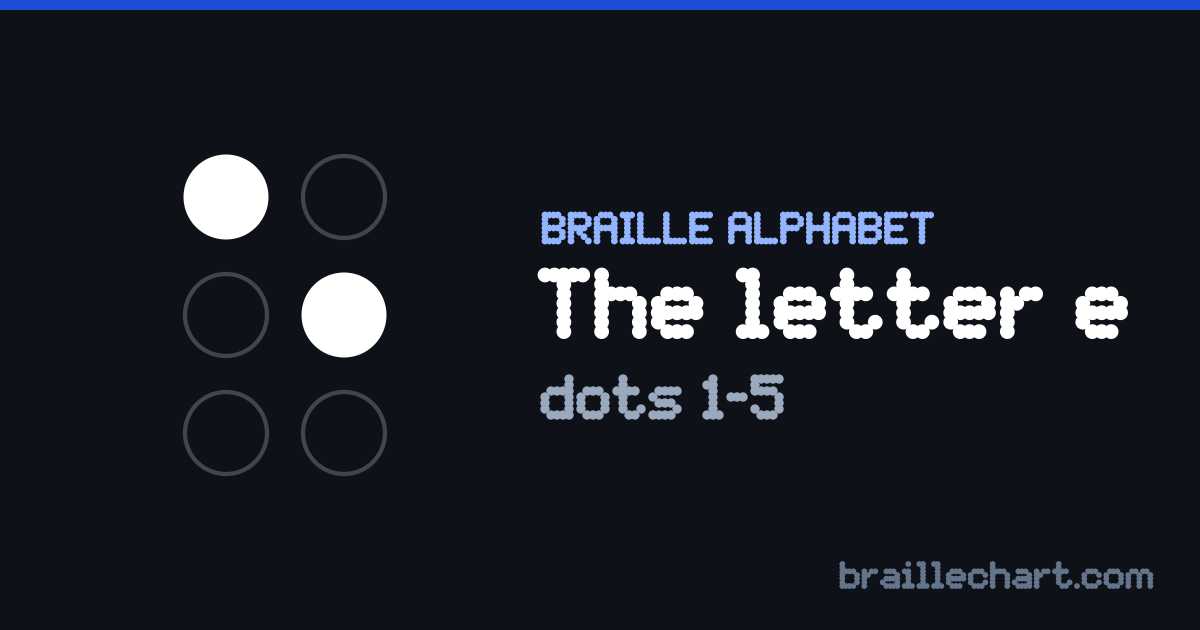
E is dots 1 and 5.
Dots 1-5
Unicode ⠑ — U+2811
How to recognise it
Dots 1 and 5 sit diagonally, top-left to middle-right. e is the most common letter in English, so it is worth over-learning this one until it is instant.
The family this letter belongs to
Braille is built from ten base shapes, and E is part of the family that starts with e. Add dot 3 to that shape and you get the second letter; add dots 3 and 6 and you get the third. Learning the family together is far faster than learning E on its own, because one shape gives you three letters. The full braille alphabet sets all ten families out side by side.
Move it down a row and it becomes punctuation
Take the shape of E and slide every dot down one position — dot 1 becomes dot 2, dot 4 becomes dot 5, and so on. The result is the “en” contraction.
This is how the punctuation marks were built, which makes them much less work to learn than they look: if you know the first ten letters you already know the shapes, and only have to remember they sit lower in the cell. The full punctuation table follows the same pattern.
E is also the digit 5
The first ten letters double as the digits. Put a number sign — dots 3-4-5-6 — in front, and every letter that follows reads as a number until a space or a letter sign ends the run. So E on its own is the letter, but after a number sign it is 5.
This is the single commonest source of confusion for people reading braille numbers — a run of digits takes one number sign at the start, not one per digit. How braille numbers work covers the whole rule.
Where E turns up in Grade 2
Standing on its own with spaces either side, E is not a letter at all — it is the whole word “every”. Inside a longer word it goes back to being an ordinary e. That is the rule beginners trip on most: every is a single cell, but the e in a word like “eat” is just a letter.
| Cell | Letters | What it does |
|---|---|---|
| ed | one cell for the letters “ed” wherever they appear together | |
| en | one cell for the letters “en” wherever they appear together | |
| er | one cell for the letters “er” wherever they appear together | |
| the | one cell for “the”, and standing alone it means “the” |
A contraction is one cell doing the work of two or more letters, which is why a Grade 2 page is roughly a quarter shorter than the same text in Grade 1. The complete Grade 2 reference lists all of them with the position rules that govern when they may be used.
Writing a capital E
Braille has no separate capital letters. A capital is the same cell with a marker in front of it: dot 6, sitting alone in its own cell. So capital E is two cells, not one.
Write that marker twice and it capitalises the entire word that follows, which is how braille handles something written in block capitals. A word in full capitals therefore costs two extra cells, however long it is.
Easily confused with
These letters differ from E by a single dot, which is where reading errors actually happen. Drill them against each other rather than in alphabetical order.
Practice words
Each word below starts with E, written in Grade 1 so every letter has its own cell.
eat
end
easy
Standing alone, E means “every”. Inside a longer word it is just the letter e. See the contraction reference for the full list.
E in braille as an image
The cell as a picture, dots 1-5 filled and the other four positions empty — for a worksheet, a slide or a message.