Grade 2
Braille contractions
Grade 2 replaces common words and letter groups with single cells. These are the wordsigns and groupsigns, with the position rules that decide when each one may actually be used.
Alphabetic wordsigns
A single letter standing alone means a whole word. Inside a longer word it is just that letter — b alone is “but”, but the b in “table” is only a b. Each letter page says which word its letter stands for and shows it in context.
| Letter | Cell | Means | Dots |
|---|---|---|---|
b | but | dots 1 and 2 | |
c | can | dots 1 and 4 | |
d | do | dots 1, 4 and 5 | |
e | every | dots 1 and 5 | |
f | from | dots 1, 2 and 4 | |
g | go | dots 1, 2, 4 and 5 | |
h | have | dots 1, 2 and 5 | |
j | just | dots 2, 4 and 5 | |
k | knowledge | dots 1 and 3 | |
l | like | dots 1, 2 and 3 | |
m | more | dots 1, 3 and 4 | |
n | not | dots 1, 3, 4 and 5 | |
p | people | dots 1, 2, 3 and 4 | |
q | quite | dots 1, 2, 3, 4 and 5 | |
r | rather | dots 1, 2, 3 and 5 | |
s | so | dots 2, 3 and 4 | |
t | that | dots 2, 3, 4 and 5 | |
u | us | dots 1, 3 and 6 | |
v | very | dots 1, 2, 3 and 6 | |
w | will | dots 2, 4, 5 and 6 | |
x | it | dots 1, 3, 4 and 6 | |
y | you | dots 1, 3, 4, 5 and 6 | |
z | as | dots 1, 3, 5 and 6 |
Groupsigns
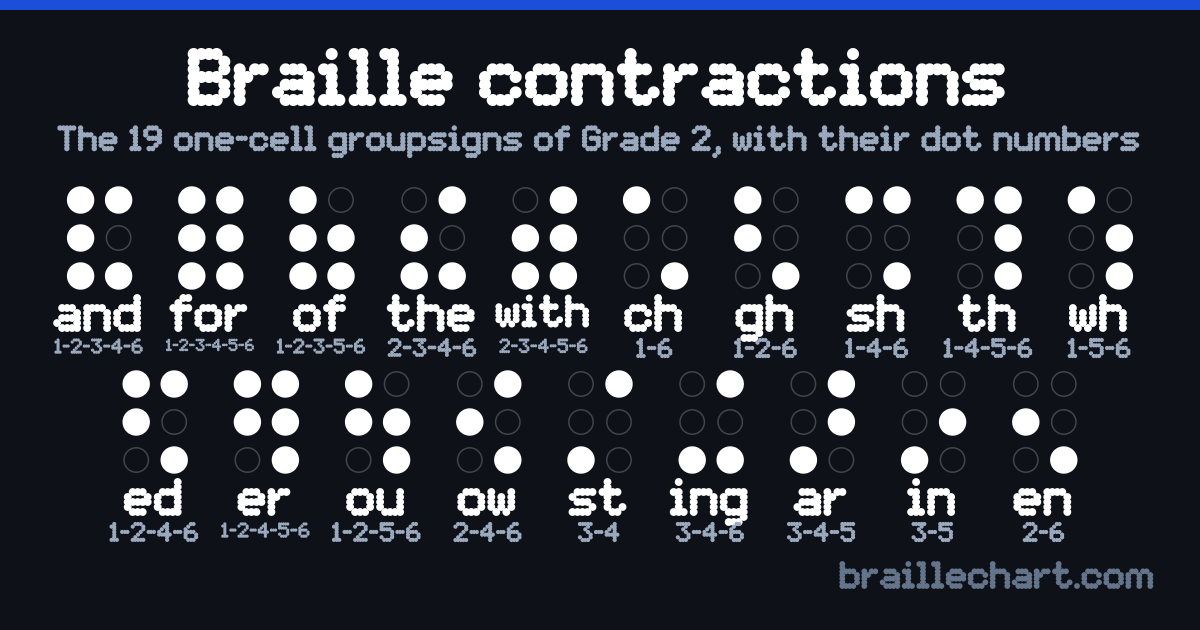
One cell standing for a letter group, usable inside a word. Some also mean a whole word when they stand alone — those are listed in the last column. Five of them exist because the alphabet ran out before the cell space did: the shapes left over went to the commonest words in English.
| Group | Cell | Dots | May start a word | Alone it means |
|---|---|---|---|---|
and | dots 1, 2, 3, 4 and 6 | Yes | and | |
for | dots 1, 2, 3, 4, 5 and 6 | Yes | for | |
of | dots 1, 2, 3, 5 and 6 | Yes | of | |
the | dots 2, 3, 4 and 6 | Yes | the | |
with | dots 2, 3, 4, 5 and 6 | Yes | with | |
ch | dots 1 and 6 | Yes | child | |
gh | dots 1, 2 and 6 | Yes | — | |
sh | dots 1, 4 and 6 | Yes | shall | |
th | dots 1, 4, 5 and 6 | Yes | this | |
wh | dots 1, 5 and 6 | Yes | which | |
ed | dots 1, 2, 4 and 6 | Yes | — | |
er | dots 1, 2, 4, 5 and 6 | Yes | — | |
ou | dots 1, 2, 5 and 6 | Yes | out | |
ow | dots 2, 4 and 6 | Yes | — | |
st | dots 3 and 4 | Yes | still | |
ing | dots 3, 4 and 6 | No | — | |
ar | dots 3, 4 and 5 | Yes | — | |
in | dots 3 and 5 | Yes | — | |
en | dots 2 and 6 | Yes | — |
Lower groupsigns
Eight more signs are written entirely in the bottom four dots. They are the part of Grade 2 that gives readers the most trouble, because every one of them shares its cell with a punctuation mark and several share it with each other — dots 2-5 is a colon, a doubled c and the prefix con- depending only on where it sits. The last column is how many of the 5,000 most common English words actually use each, which is a better guide to what to learn first than the order they are usually taught in.
| Sign | Cell | Dots | Where it may sit | In 5,000 common words |
|---|---|---|---|---|
ea | dot 2 | Only between two letters | 150 words | |
con- | dots 2 and 5 | Only at the start of a word | 88 words | |
dis- | dots 2, 5 and 6 | Only at the start of a word | 27 words | |
cc | dots 2 and 5 | Only between two letters | 26 words | |
be- | dots 2 and 3 | Only at the start of a word | 24 words | |
ff | dots 2, 3 and 5 | Only between two letters | 21 words | |
gg | dots 2, 3, 5 and 6 | Only between two letters | 7 words | |
bb | dots 2 and 3 | Only between two letters | 3 words |
Final-letter contractions
12 suffixes are written as a prefix cell plus the sequence's last letter. Unlike the initial-letter list these appear inside and at the end of words, never at the start — “ancestor” and “lesson” are spelled out in full because the contraction cannot open a word.
Dots 5-6 is also the letter sign, and dot 6 is also the capital sign. Braille resolves that the way a reader does — by position. A capital sign sits in front of a word; a final-letter contraction never does. The same cell means different things depending on where in the word it falls, which is why braille cannot be decoded one cell at a time.
Where several spellings are valid, UEB takes the one with fewest cells. “thence” is written th-ence in three cells rather than the-n-c-e in four, even though the “the” sign is the longer match. The translator picks the shortest form for the whole word rather than the longest match at each step.
Initial-letter contractions
33 words are written as a prefix cell plus one more cell — two cells for the whole word, however long it is. The prefix carries no meaning alone; it says which of three groups the next cell belongs to. These are among the commonest words in English, which is why they were given the shortest forms.
“there” uses the “the” groupsign, “character” uses “ch”, “ought” uses “ou”. The prefix plus a groupsign is still two cells, and the pairing is arbitrary enough that it has to be learned rather than worked out.
| Word | In braille | Prefix | Second cell | Cells |
|---|---|---|---|---|
| cannot | dots 4-5-6 | the letter c | 2 of 6 | |
| character | dots 5 | the ch sign | 2 of 9 | |
| day | dots 5 | the letter d | 2 of 3 | |
| ever | dots 5 | the letter e | 2 of 4 | |
| father | dots 5 | the letter f | 2 of 6 | |
| had | dots 4-5-6 | the letter h | 2 of 3 | |
| here | dots 5 | the letter h | 2 of 4 | |
| know | dots 5 | the letter k | 2 of 4 | |
| lord | dots 5 | the letter l | 2 of 4 | |
| many | dots 4-5-6 | the letter m | 2 of 4 | |
| mother | dots 5 | the letter m | 2 of 6 | |
| name | dots 5 | the letter n | 2 of 4 | |
| one | dots 5 | the letter o | 2 of 3 | |
| ought | dots 5 | the ou sign | 2 of 5 | |
| part | dots 5 | the letter p | 2 of 4 | |
| question | dots 5 | the letter q | 2 of 8 | |
| right | dots 5 | the letter r | 2 of 5 | |
| some | dots 5 | the letter s | 2 of 4 | |
| spirit | dots 4-5-6 | the letter s | 2 of 6 | |
| their | dots 4-5-6 | the the sign | 2 of 5 | |
| there | dots 5 | the the sign | 2 of 5 | |
| these | dots 4-5 | the the sign | 2 of 5 | |
| those | dots 4-5 | the th sign | 2 of 5 | |
| through | dots 5 | the th sign | 2 of 7 | |
| time | dots 5 | the letter t | 2 of 4 | |
| under | dots 5 | the letter u | 2 of 5 | |
| upon | dots 4-5 | the letter u | 2 of 4 | |
| where | dots 5 | the wh sign | 2 of 5 | |
| whose | dots 4-5 | the wh sign | 2 of 5 | |
| word | dots 4-5 | the letter w | 2 of 4 | |
| work | dots 5 | the letter w | 2 of 4 | |
| world | dots 4-5-6 | the letter w | 2 of 5 | |
| young | dots 5 | the letter y | 2 of 5 |
UEB allows most of these inside a longer word when the pronunciation survives — “partly”, “everything”, “grandmother”. Which positions are safe is not stated as a list anywhere, so this site measured every one of them against the reference translator and recorded the answer per word: 31 of the 33 may appear inside a longer word, and each is restricted to the positions that agreed. “those” and “cannot” are whole words only. Each word’s page gives its own rule.
Shortforms
A shortform is a whole word written with an abbreviated sequence of letters, which is then contracted normally on top — “against” is written a-g-st, and the st itself becomes one cell. These are the largest single saving in Grade 2: across the list below, words that take 6.6 cells spelled out take 2.6 written short.
| Word | Written as | In braille | Cells | Endings it keeps |
|---|---|---|---|---|
| about | ab | 2 of 5 | none | |
| above | abv | 3 of 5 | -s | |
| according | ac | 2 of 9 | -ly | |
| across | acr | 3 of 6 | none | |
| after | af | 2 of 5 | -s, -ship | |
| afternoon | afn | 3 of 9 | -s | |
| afterward | afw | 3 of 9 | -s | |
| again | ag | 2 of 5 | none | |
| against | agst | 3 of 7 | none | |
| almost | alm | 3 of 6 | none | |
| already | alr | 3 of 7 | none | |
| also | al | 2 of 4 | none | |
| although | alth | 3 of 8 | none | |
| altogether | alt | 3 of 10 | none | |
| always | alw | 3 of 6 | none | |
| because | bec | 2 of 7 | none | |
| before | bef | 2 of 6 | none | |
| behind | beh | 2 of 6 | -s | |
| below | bel | 2 of 5 | -s | |
| beneath | ben | 2 of 7 | none | |
| beside | bes | 2 of 6 | -s | |
| between | bet | 2 of 7 | -s | |
| beyond | bey | 2 of 6 | -s | |
| blind | bl | 2 of 5 | -s, -ly, -ness, -less | |
| children | chn | 2 of 8 | none | |
| conceive | concv | 3 of 8 | -s, -d, -r | |
| conceiving | concvg | 4 of 10 | none | |
| could | cd | 2 of 5 | -est | |
| deceive | dcv | 3 of 7 | -s, -d, -r | |
| deceiving | dcvg | 4 of 9 | none | |
| declare | dcl | 3 of 7 | -s, -d, -r | |
| declaring | dclg | 4 of 9 | none | |
| either | ei | 2 of 6 | none | |
| first | fst | 2 of 5 | -s, -ly, -ness, -ship | |
| friend | fr | 2 of 6 | -s, -ly, -ship, -less | |
| good | gd | 2 of 4 | -s, -er, -ers, -ly, -ness, -ship, -less | |
| great | grt | 3 of 5 | -s, -er, -ly, -est, -ness | |
| herself | herf | 3 of 7 | none | |
| him | hm | 2 of 3 | none | |
| himself | hmf | 3 of 7 | none | |
| immediate | imm | 3 of 9 | -ly, -ness | |
| its | xs | 2 of 3 | none | |
| itself | xf | 2 of 6 | none | |
| letter | lr | 2 of 6 | -s, -ed, -er, -ers, -ing, -less | |
| little | ll | 2 of 6 | -s, -r, -ness | |
| much | mch | 2 of 4 | -ly, -ness | |
| must | mst | 2 of 4 | -s | |
| myself | myf | 3 of 6 | none | |
| necessary | nec | 3 of 9 | none | |
| neither | nei | 3 of 7 | none | |
| o'clock | o'c | 3 of 7 | none | |
| ourselves | ourvs | 4 of 9 | none | |
| paid | pd | 2 of 4 | none | |
| perceive | percv | 4 of 8 | -s, -d, -r | |
| perceiving | percvg | 5 of 10 | none | |
| perhaps | perh | 3 of 7 | -es | |
| quick | qk | 2 of 5 | -s, -er, -ly, -est, -ness | |
| receive | rcv | 3 of 7 | -s, -d, -r | |
| receiving | rcvg | 4 of 9 | none | |
| rejoice | rjc | 3 of 7 | -s, -d, -r, -ful | |
| rejoicing | rjcg | 4 of 9 | -ly | |
| said | sd | 2 of 4 | -s | |
| should | shd | 2 of 6 | -est | |
| such | sch | 2 of 4 | none | |
| themselves | themvs | 4 of 10 | none | |
| today | td | 2 of 5 | -s | |
| together | tgr | 3 of 8 | -s, -ness | |
| tomorrow | tm | 2 of 8 | -s | |
| tonight | tn | 2 of 7 | -s | |
| would | wd | 2 of 5 | -est | |
| your | yr | 2 of 4 | -s | |
| yourself | yrf | 3 of 8 | none | |
| yourselves | yrvs | 4 of 10 | none |
UEB lets a shortform stand for its word inside a derived form — “friends” is the friend shortform then an s — but not where the letters merely coincide, and “shoulder” is not “should” plus an er. The usual treatment gives one list of endings for all seventy-three words. That does not hold: “greater”, “goodness” and “lettering” all keep their shortform, while “abouts”, “blindest” and “deceivingly” do not. So this site measured every word against the reference translator separately, and the last column is the result.
The be- shortforms — because, before, behind, below, beneath, beside, between and beyond — do not begin with the letters b and e. They open with a single cell, dots 2-3, which is the same cell as the semicolon. Position tells them apart: in front of a word it is the prefix, after one it is punctuation. That is why “because” is two cells rather than seven.
Why position matters
Several contractions are written in the lower part of the cell, and where they sit in a word decides whether they may be used at all — sometimes whether they mean anything at all.
The ing sign may not begin a word: "running" ends with it, but "ingredient" opens with the in sign and a g instead. The ea, bb, cc, ff and gg signs must have a letter on both sides: "read" is r-ea-d, while "sea" and "eat" are spelled out. The con- and dis- signs are the other way round — they must open the word, so "contact" uses one and "bacon" does not.
And one cell can be three different things depending on position. Dots 2-3-6 standing alone between spaces is the word "his"; opening a word it is a quotation mark; closing one it is a question mark. Nothing about the cell says which. This is what makes contracted braille hard to automate, and why output from any tool should be checked before it is embossed.
Measured against liblouis 3.29.0 (en-ueb-g2), the reference implementation braille displays and embossers run, over the 5,000 most common English words: 99.7% of words identical, and 99.9% once weighted by how often each word actually occurs. That comparison runs on every build, so this figure cannot drift away from what the translator does. The method, and all fourteen disagreements, are published in full.
- All 65 shortforms (ab for about, bec for because, o'c for o'clock)
- All 33 initial-letter contractions as standalone words (one, day, time, their, question)
- All 14 final-letter contractions (-ment, -tion, -ness, -ful, -ity, -ance, -ation and the rest)
- Shortest-form selection — where several spellings are valid, the one with fewest cells is chosen
- All 23 alphabetic wordsigns (but, can, do, every, from, ...)
- All 19 strong groupsigns (and, for, of, the, with, ch, sh, th, ...)
- Strong wordsigns standing alone (child, shall, this, which, out, still)
- The lower groupsigns ea, bb, cc, ff and gg, with the rule that keeps them between letters (read, rubber, bigger — but not sea or eat)
- The con- and dis- prefixes, including the spellings that are not the prefix (contact but not cone, display but not disc)
- The lower wordsigns be, enough, his, in, was and were standing alone
- Initial-letter contractions inside longer words as well as alone (b-one, ph-one, net-work, part-y), in the positions where that agrees with the reference more often than not. There are four positions, because a trailing plural s is its own case: the one contraction ends a word 96% of the time, ends it before an s 85% of the time, and sits in the middle of one 16% of the time, so it is allowed in the first two and not the third
- The be- prefix, which applies only where be is a syllable of its own — begin and become take it, best and bench do not. That distinction is about pronunciation, so it follows the reference implementation's own patterns: 98.4% agreement across all 3,676 English words beginning be
- Words spelt like a shortform, which are written so they cannot be read as one — agst drops its contraction, and ab, which has none to drop, takes a grade 1 word indicator instead
- Shortforms carrying an ending: friends, friendly, friendless, greatest, declared, receiver. The endings allowed are the ones measured safe, because shoulder is not should plus an er
Not covered:
- A shortform buried inside an unrelated word (newsletter, aboutface, greatgrandmother) — the reference contracts about 600 of those from a list of individual words rather than by rule, and this engine spells them out instead: longer, but never a contraction that reads as the wrong word
- The last words where an initial-letter contraction must not be used inside them (money, reverse) — position removes most of these but not all, and what remains is about meaning rather than spelling
- Four abbreviations the reference gives a grade 1 indicator from a word list rather than a rule (blvd, bldg, llc, llb) — over the 8,624 dictionary words whose cells open with a shortform, those four are the only ones that get it, so there is no rule here to follow
- The groupsigns ed, er and ow standing alone as whole words, which the reference writes as a single cell while spelling out ar, en, gh and ing in the same position — this engine spells all of them out, which is longer and unambiguous
- Context rules that depend on syllable boundaries or pronunciation
- Typeform indicators for bold, italic and underline
Good enough to read, learn from, and check your work against. Not a substitute for a certified transcription — if the output is going to be embossed for someone to rely on, have a qualified transcriber check it.
The groupsigns as one image
The one-cell groupsigns with their dot numbers, on a chart you can print or put in front of someone learning them.