Letter 14 of 26
The letter N in braille
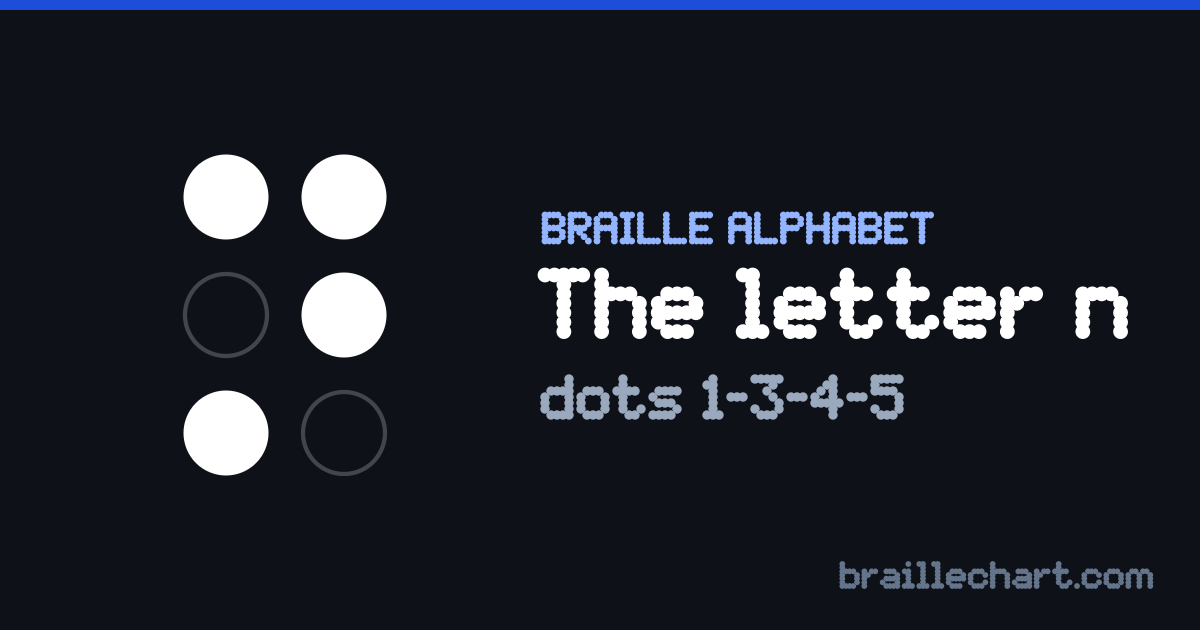
N is dots 1, 3, 4 and 5.
Dots 1-3-4-5
Unicode ⠝ — U+281D
How to recognise it
Dots 1, 3, 4 and 5. n is d plus dot 3; in the left column only dot 2 is empty.
D, N and Y: one shape
N is D with dot 3 added; add dot 6 as well and it becomes Y.
Where N turns up in Grade 2
Standing alone, N is the word “not”. Inside a word it is the letter again: “new” is ⠝⠑⠺.
| Cell | Letters | What it does |
|---|---|---|
| and | one cell for “and”, whether it is a word of its own or letters inside one | |
| ing | one cell for the letters “ing”, but never at the start of a word | |
| en | one cell for the letters “en”; standing alone it is the word “enough” | |
| in | one cell for the letters “in”; standing alone it is the word “in” | |
| con | one cell for “con” at the start of a word |
The contraction reference gives the rules for each.
Writing a capital N
Capital N is two cells: the capital sign, dot 6, then N. A word in capitals takes the sign twice, once for the whole word: “NEW” is ⠠⠠⠝⠑⠺. Capitals covers longer runs.
Easily confused with
N differs by a single dot from D, M, O, Q and Y — the letters to drill it against.
Practice words
Words that start with N, one cell per letter in Grade 1. Where Grade 2 writes one shorter, that form follows.
not
Grade 2: ⠝ — 1 cell instead of 3
new
name
Grade 2: ⠐⠝ — 2 cells instead of 4
In a whole book
In a count over the whole of Alice’s Adventures in Wonderland, the letter n is printed 7,009 times. Grade 2 still writes it as its own cell 2,229 times, 31.8%. The other 4,780 are inside contractions, most often “ing” (983), “and” (950), “in” (916) and “en” (726).
The cell itself is written 2,475 times in the Grade 2 text: 2,229 as the letter, 138 as the word “not”, 12 inside shortforms and 96 as the second cell of a two-cell contraction.
N in braille as an image