Reference
Numbers in braille
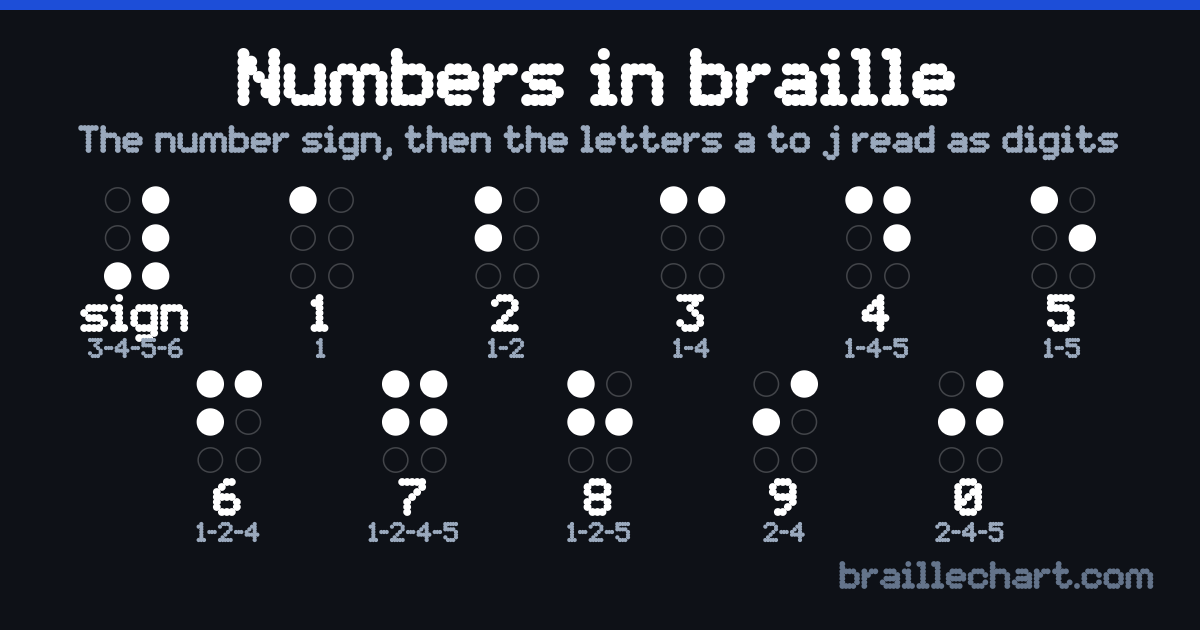
Braille has no separate digits. The number sign switches the letters a to j into the digits 1 to 9 and 0, and everything after it reads as a number until a space.
The number sign — dots 3-4-5-6
Turns the following letters a-j into the digits 1-9 and 0.
Where a number starts and stops
This is the part worth getting right, because a mistake here does not make the writing unclear — it makes it say a different number. A numeric run opens with the number sign and then continues until something closes it. Three things can follow a digit, and they behave differently.
A space closes the run
After a space, letters are letters again and nothing extra is needed.
A letter from a to j must be marked
The digits are written with the cells for a to j, so a letter in that range immediately after a digit is indistinguishable from another digit. The letter sign — dots 5-6 — says “this is a letter”. Written correctly, 10cm is:
Leave the letter sign out and the cells read back as “103m”. That is not an ugly transcription, it is a wrong one, and it is invisible to a sighted proofreader — the cells look perfectly reasonable. This is the single commonest error in hand-written braille numbers.
A letter from k to z needs nothing
No digit is written with those cells, so there is nothing to confuse. 1st, 10kg and 5m are written straight through:
Decimal points and thousands separators keep it open
A decimal point does not end the number, so the digits after it carry no second number sign. The same is true of a comma separating thousands.
| Written | In braille | Number signs used |
|---|---|---|
| 3.14 | one | |
| 1,000 | one | |
| 0.5 | one | |
| I have 3. Yes. | one — the final stop is not followed by a digit, so it closes the run |
The last row is the distinction that matters: the same cell is a decimal point inside a number and a full stop at the end of a sentence. What tells them apart is whether a digit follows.
Writing longer numbers
A run of digits takes one number sign, not one per digit. The year 2026 is the number sign followed by b, j, b, f — four cells after a single indicator.
The number sign stays in effect until a space or a letter interrupts it, which is why a letter immediately after digits sometimes needs a letter sign (dots 5-6) to make clear it is a letter and not another digit.
2026
42
Where you will meet this
Lift buttons are the commonest place. A floor number beside a lift button is the number sign plus the letter for that digit, which is why the button for floor 1 reads as the number sign followed by the letter a — see braille on signs and lifts.
Numbers past nine
Everything above covers a single digit. Longer numbers follow the same rule and need nothing extra: one number sign at the start, then the digits. So 100 is four cells, not six.
The full table from 1 to 100 writes out every number with its dot numbers and cell count, along with the round hundreds and thousands. It is the page to print if you are teaching numbers rather than looking one up.
The digits as one image
The number sign and all ten digits on a single chart. The sign comes first and covers everything after it, which is the part a chart of digits alone leaves out.