Letter 17 of 26
The letter Q in braille
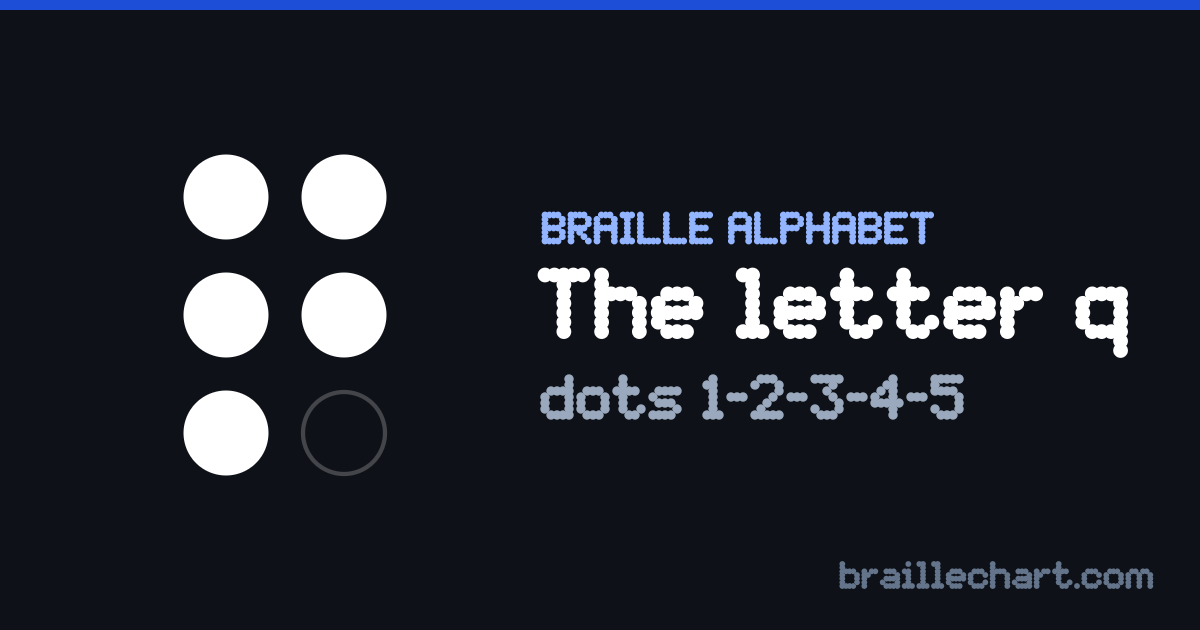
Q is dots 1, 2, 3, 4 and 5.
Dots 1-2-3-4-5
Unicode ⠟ — U+281F
How to recognise it
Dots 1, 2, 3, 4 and 5 — five of the six dots raised, everything except dot 6. It is one of the fullest cells.
G, Q and the “for” sign
Q is G with dot 3 added; add dot 6 as well and the cell is the “for” sign, ⠿, rather than a letter.
Adding dots 3 and 6 turns a, b, c, d and e into u, v, x, y and z. For f, g, h, i and j the same step gives the words and, for, of, the and with — so g plus dots 3 and 6 is “for”, not a letter. The contraction reference lists all five.
Where Q turns up in Grade 2
Standing alone, Q is the word “quite”. Inside a word it is the letter again: “quiz” is ⠟⠥⠊⠵.
Writing a capital Q
Capital Q is two cells: the capital sign, dot 6, then Q. A word in capitals takes the sign twice, once for the whole word: “QUIZ” is ⠠⠠⠟⠥⠊⠵. Capitals covers longer runs.
Easily confused with
Q differs by a single dot from G, N, P, R and T — the letters to drill it against.
Practice words
Words that start with Q, one cell per letter in Grade 1. Where Grade 2 writes one shorter, that form follows.
quiz
quiet
queen
Grade 2: ⠟⠥⠑⠢ — 4 cells instead of 5
In a whole book
In a count over the whole of Alice’s Adventures in Wonderland, the letter q is printed 209 times. Grade 2 still writes it as its own cell 130 times, 62.2%. The other 79 are inside contractions, most often “quite” (53), “question” (21) and “quick” (5).
The cell itself is written 209 times in the Grade 2 text: 130 as the letter, 53 as the word “quite”, 5 inside shortforms and 21 as the second cell of a two-cell contraction.
Q in braille as an image