Grade 2 contraction
The “th” contraction in braille
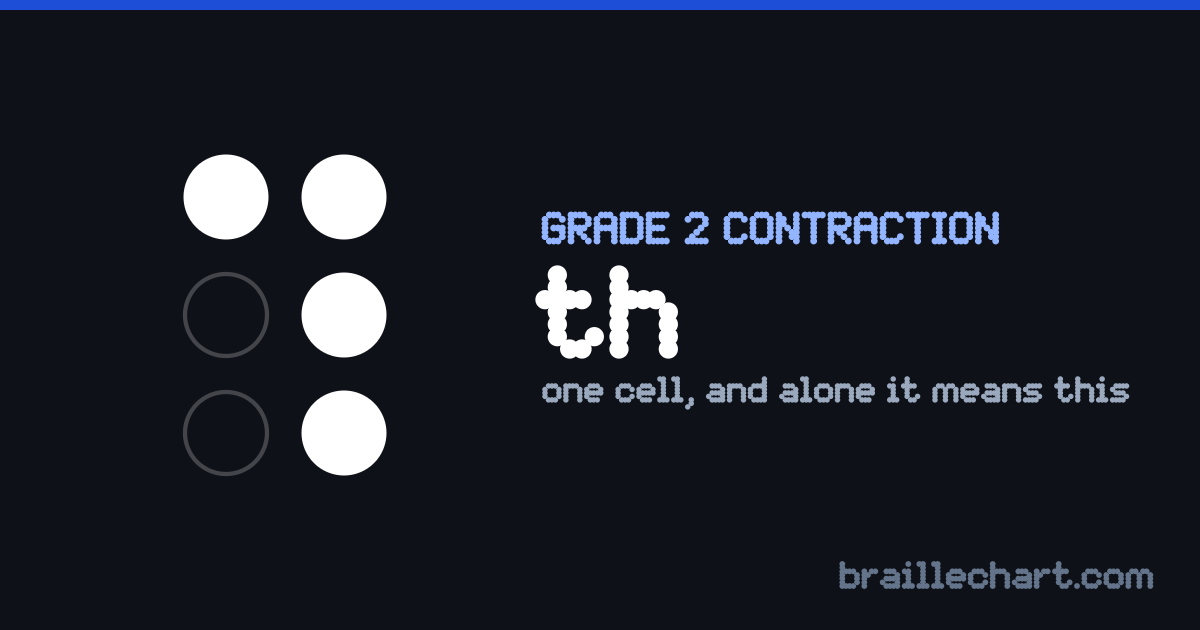
One cell for the letters “th”, and standing on its own it means “this”.
Dots 1-4-5-6
Unicode ⠹ — replaces the letters th
How to recognise it
Dots 1, 4, 5 and 6. Standing alone it means “this”.
On its own it means “this”
With a space either side, this cell is not the letters “th” at all — it is the whole word “this”. Inside a longer word it goes back to standing for just the letter group. One cell, two jobs, told apart by whether it is surrounded by spaces.
“this” on its own
inside “path”
Words that use it
Each of these is shorter in Grade 2 than in Grade 1, because the letters “th” collapse into a single cell wherever the rules allow it.
| Word | In braille (Grade 2) | Grade 1 | Grade 2 |
|---|---|---|---|
| this | 4 cells | 1 cell | |
| path | 4 cells | 3 cells | |
| three | 5 cells | 4 cells |
Where it does not apply
These are the ones that catch people out — words that contain the letters but do not take the contraction. Knowing why is more useful than memorising the list.
| Word | Written as | Why |
|---|---|---|
| with | “with” has its own whole-word cell, so the th inside it never appears |
Contractions it is confused with
These differ from “th” by a single dot, which is where reading errors actually happen. Under a fingertip a missing or extra dot is far easier to miss than a completely different shape, so these are the ones worth drilling against each other.
Check your own text
Type anything into the translator with Grade 2 selected and this cell will appear wherever the rules allow it. The full contraction list shows the other eighteen, and Grade 1 versus Grade 2 explains when contracted braille is the right choice at all.
The “th” cell as an image
One cell — dots 1, 4, 5 and 6 — as a picture for a handout or a slide.