Punctuation
The full stop in braille
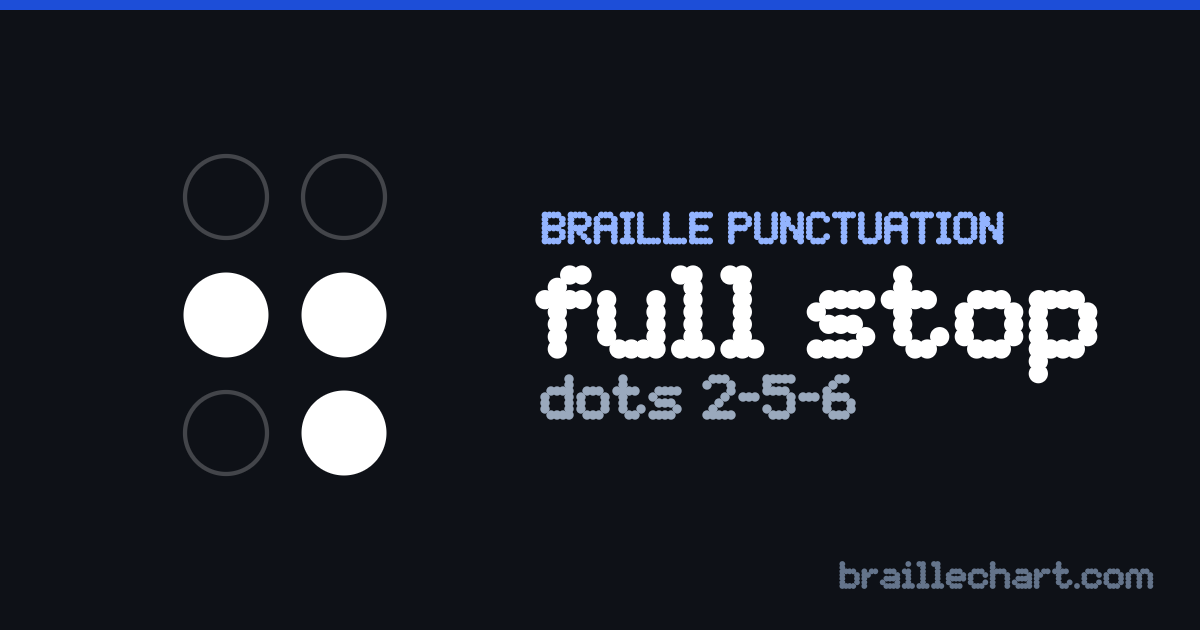
Full stop is dots 2, 5 and 6 — a single cell.
2-5-6
One cell — full stop / period
How to recognise it
Dots 2, 5 and 6. The commonest mark in English prose, and the one that also serves as the decimal point inside a number.
It is the letter d moved down a row
Take the cell for d and slide every dot down one position — dot 1 becomes dot 2, dot 4 becomes dot 5 — and you have the full stop. Six of the eight single-cell marks were built this way, which means a reader who knows the first ten letters already knows the shapes and only has to remember they sit lower in the cell.
In a sentence
Here is the full stop doing its job, written in Grade 1 so every letter has its own cell.
The book was long. It was worth it.
Try your own text in the translator, or paste braille into the decoder to read it back.
Marks it is confused with
These differ by a single dot. Punctuation is harder to tell apart than letters because the marks are small and sit low in the cell, so a missing dot is easy to miss.
| Cell | Mark | Dots |
|---|---|---|
| Colon | 2-5 |
The full stop as an image
The cell is dots 2, 5 and 6, with the top row empty — which is what tells a reader it is punctuation and not a letter.