Punctuation
The hyphen in braille
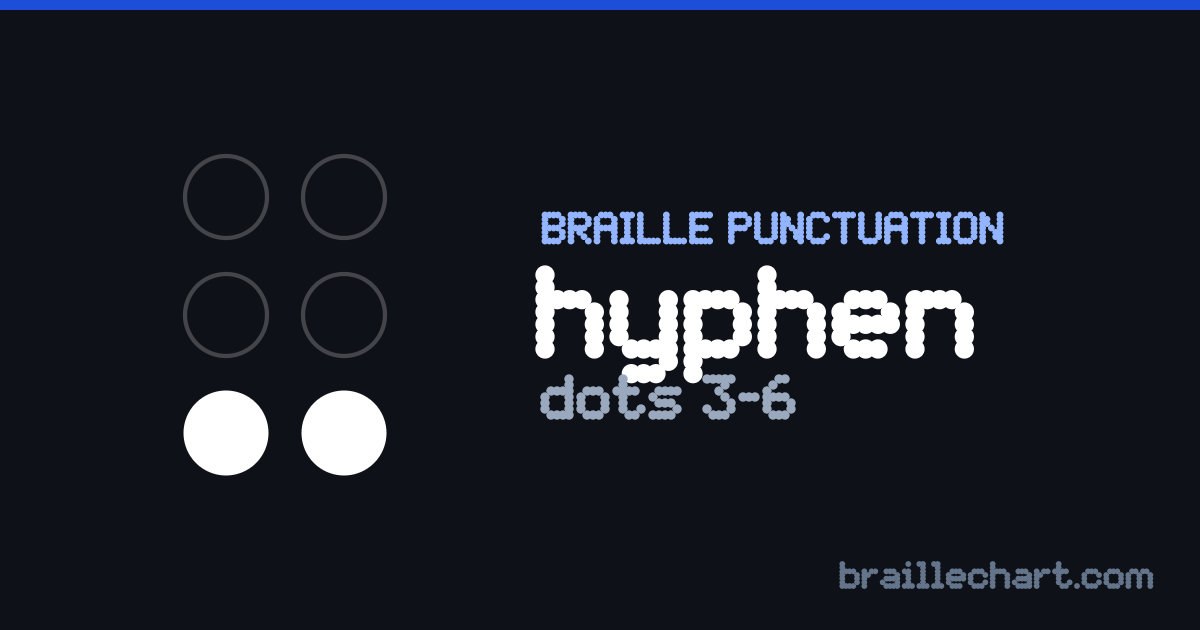
Hyphen is dots 3 and 6 — a single cell.
3-6
One cell — hyphen
How to recognise it
Dots 3 and 6, the two bottom dots. Like the apostrophe it sits outside the lower-sign pattern.
It is not built from a letter
Most single-cell marks are one of the first ten letters shifted down a row. The hyphen is one of the two that is not — it stands on its own, so there is no shortcut and it simply has to be learned. The other marks mostly do follow the pattern.
In a sentence
A well-known writer.
In Grade 2, the same cell: No second reading, and three lengths of line
The hyphen is no contraction in Unified English Braille. The dash is the same cell with dot 6 before it, and the long dash adds dot 5 before that, used only where print sets a short and a long dash apart (rule 7.2.4): Mr D—— visits ⠠⠍⠗ ⠰⠠⠙⠐⠠⠤ ⠧⠊⠎⠊⠞⠎.
A hyphen ends a number, so the number after it takes its own number sign (rule 6.3.1): 9-10 ⠼⠊⠤⠼⠁⠚. And a lower word sign is not used in contact with it (rule 10.5.1), so his is spelled out here: his-and-hers ⠓⠊⠎⠤⠯⠤⠓⠻⠎.
Marks it is confused with
The hyphen is one dot away from the question mark and the apostrophe.
| Cell | Mark | Dots |
|---|---|---|
| Question mark | 2-3-6 | |
| Apostrophe | 3 |
The hyphen as an image