Research
Where a contraction may sit inside a word
The rule is that the letters must keep their meaning. Spelling cannot decide that, so this is what the reference actually does, over 11,014 words.
There are 33 common words with a two-cell contraction of their own: one, day, time, there, under, question. Used as whole words they are straightforward. Used inside a longer word they are governed by a rule that reads well and cannot be executed: the contraction may be used where the letters keep their meaning.
Someone keeps the one. Component does not, though the letters are identical. Nothing about the spelling of either word says which. Meaning is not a property a translator can see.
The method
- Question
- When these letters appear inside a longer word, does the reference use the contraction — and does where they sit predict it?
- Compared against
- liblouis 3.29.0 (en-ueb-g2), using its published UEB Grade 2 table.
- Over
- Every word in a large English word list containing one of the 33 contractions without being it: 11,014 words, 11,466 observations, since a word can contain more than one.
- Committed as
forge/topics/braille/data/initial-contraction-positions.tsv
Position carries most of the signal
| Position | Kept | Of | Rate |
|---|---|---|---|
| Start of the word | 2,487 | 2,639 | 94.2% |
| End of the word | 2,369 | 2,581 | 91.8% |
| End of the word except for a plural s | 592 | 706 | 83.9% |
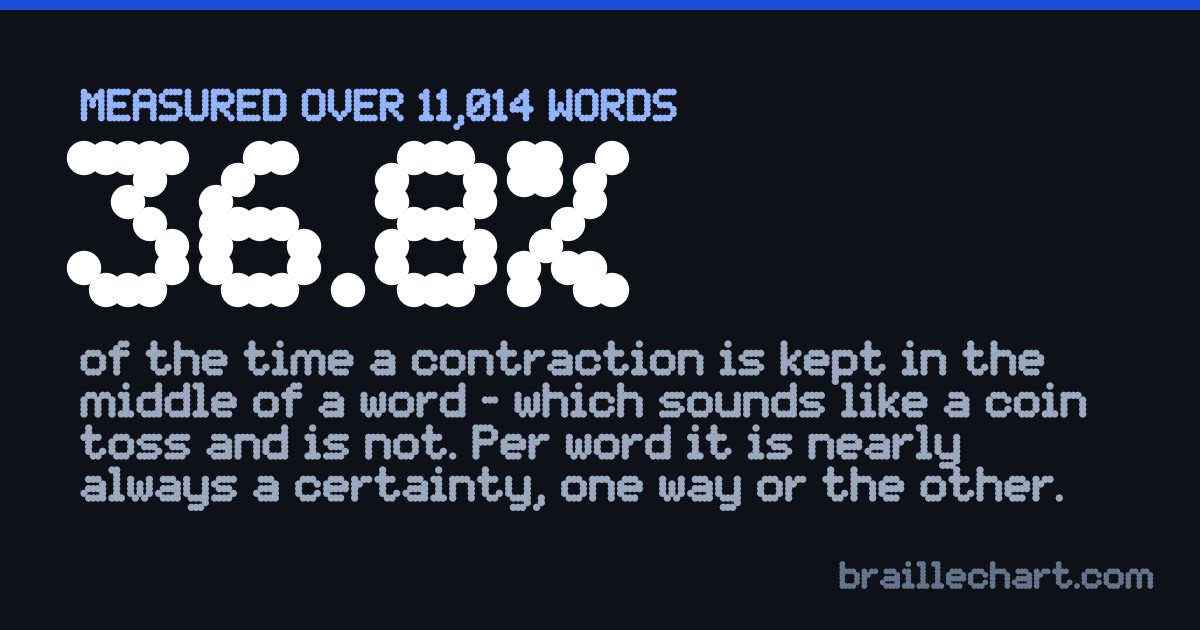
| Middle of the word | 2,036 | 5,540 | 36.8% |
Three of the four are decided. At the start of a word the contraction is kept almost always; at the end almost always; in the middle, apparently, a coin toss.
Which is where most treatments stop, and where the useful part begins.
The fourth position
There are three obvious positions — start, middle, end — and measuring only those gets a real answer wrong.
A word like ones, phones, tones or theirs has the contraction at the end except for a plural s. Counted as “middle”, they drag the middle rate down and, worse, an engine that follows the middle rule spells them out. The reference keeps the contraction in 83.9% of them: a trailing s behaves like the end of the word, not like the middle of it.
So the survey uses four positions and checks the trailing s case before the other three. That change alone recovered several very common words.
The middle is not one case
Splitting the middle by which contraction is involved — every one with at least 20 examples — the aggregate 36.8% turns out to be an average of two populations that barely overlap.
| Contraction | Kept | Of | Rate |
|---|---|---|---|
| know | 74 | 74 | 100.0% |
| part | 307 | 307 | 100.0% |
| spirit | 55 | 55 | 100.0% |
| word | 52 | 52 | 100.0% |
| work | 138 | 138 | 100.0% |
| right | 136 | 139 | 97.8% |
| ought | 58 | 61 | 95.1% |
| day | 25 | 29 | 86.2% |
| under | 149 | 184 | 81.0% |
| some | 180 | 277 | 65.0% |
| time | 102 | 182 | 56.0% |
| ever | 200 | 385 | 51.9% |
| mother | 26 | 69 | 37.7% |
| name | 22 | 124 | 17.7% |
| one | 414 | 2,660 | 15.6% |
| had | 15 | 188 | 8.0% |
| here | 7 | 408 | 1.7% |
| there | 0 | 120 | 0.0% |
14 of the 18 are above 80 per cent or below 20. Only 4 sit anywhere in the middle.
The words at the top are the ones whose letters are almost always a real part of the longer word: part in department and apartment, work in networking, know in unknown. The words at the bottom are common letter strings that land inside unrelated words: here inside therefore, name inside tournament, one inside component and commissioner and pioneer.
That is why a single rule about the middle of a word cannot work, and why a rule per contraction can. It is not a linguistic law — it is what the reference does, and it is consistent enough per word to act on.
one is kept in the middle only 15.6% of the time, so this site's engine declines it — and one of the words it therefore spells out is money, which the reference contracts. That single word is the most common disagreement in the whole conformance test. Setting the rule the other way would fix it and break several hundred others.
What this site does with it
Each of the 33 contractions carries the list of positions where agreeing with the reference is likelier than disagreeing, and the engine allows exactly those. A test checks the rules against the survey on every build, so the two cannot drift apart.
Each contraction's page states its own positions and the measurement behind them. The finder shows the rule firing on a word you choose, including the cases where a contraction was legal and declined. The other measurements cover the reference tables, contraction positions and page counts.
The finding, as a card
The aggregate number, which is the one worth arguing with.