Phrase
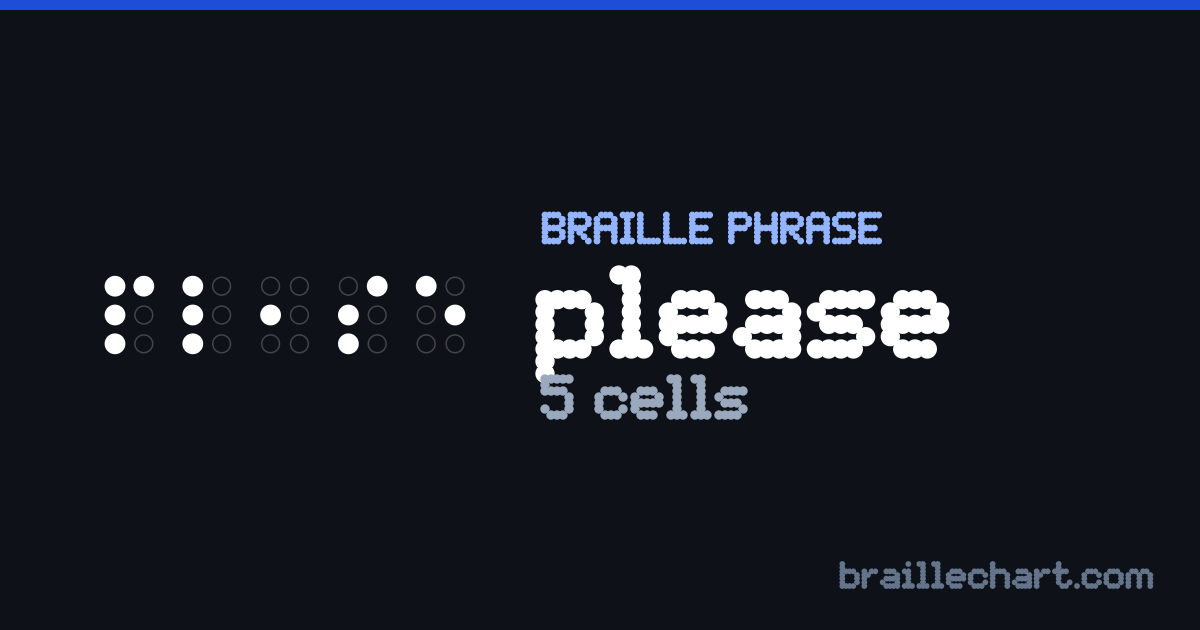
“please” in braille
Contains 'ea' and a doubled e, which makes it a good test of letter-by-letter accuracy.
Grade 1 — letter by letter
6 cells
Grade 2 — contracted
5 cells — 1 fewer than Grade 1.
What Grade 2 changed, word by word
Grade 2 takes this phrase from 6 cells to 5 — 1 cell shorter. One word accounts for it, and here is exactly which rule applied to each.
| Word | Grade 1 | Grade 2 | What happened |
|---|---|---|---|
| please | 6 cells | 5 cells | the groups each become one cell |
A contraction is not an abbreviation — the word is still spelled in full, it is just written with fewer cells. A Grade 2 reader sees no difference in meaning, only in length. All the contractions are listed with the position rules that decide when each may be used.
Letter by letter
Before you emboss it
If this is going onto something permanent — jewellery, a card, a tattoo — decide which grade you want first. The two are different lengths and a Grade 2 reader will read the Grade 1 version perfectly well, but not the other way round if the contraction is misapplied.
See the bracelet pattern maker for turning this into a physical layout.
The same thing, in the other codes
Each of these is what someone says in that language at the same moment — not a translation of the English, but the phrase that language's own list already carried. The cells come from each code's own engine.
| Language | Phrase | In braille | Cells |
|---|---|---|---|
| English | please | ⠏⠇⠑⠁⠎⠑ | 6 |
| Spanish | por favor | ⠏⠕⠗ ⠋⠁⠧⠕⠗ | 8 |
| Portuguese | por favor | ⠏⠕⠗ ⠋⠁⠧⠕⠗ | 8 |
| Hindi | कृपया | ⠅⠐⠗⠏⠽⠜ | 6 |
“please” as an image
The Grade 2 cells drawn, for a card, a stencil or a message.